From 1 rack
Configurations suited to your business scale

DATA CENTER DEVELOPMENT
With KAMUI immersion cooling racks at the core, we support AI infrastructure from micro data centers to large-scale facilities. We support both the infrastructure and the business.
OUR APPROACH
Every customer has different sites, GPUs, and uses for computing resources. Quantum Mesh designs configurations around your use case and scale, bringing post-opening monitoring and maintenance, computing capacity sales, and revenue management into one plan.
Configurations suited to your business scale
Design with the latest GPUs in mind
Support that continues after opening
Scale, performance, costs, schedule, and service scope are proposed individually after reviewing equipment and site conditions.
SCALABILITY
From a single-rack micro data center to a large-scale AI facility.We propose immersion cooling racks and facility configurations to suit your use case, deployment scale, and site conditions.
Rack counts are a guide to product selection.Large-scale configurations are individually designed by combining multiple units after reviewing power, cooling, and site conditions.Product images are illustrative.
MICRO

For micro data centers and on-premises AI environments.Supports the deployment of small-scale, in-house computing infrastructure.
SMALL SCALE

For AI and GPU workloads at enterprises and research institutions.We build a consolidated computing infrastructure tailored to your use case.
LARGE SCALE
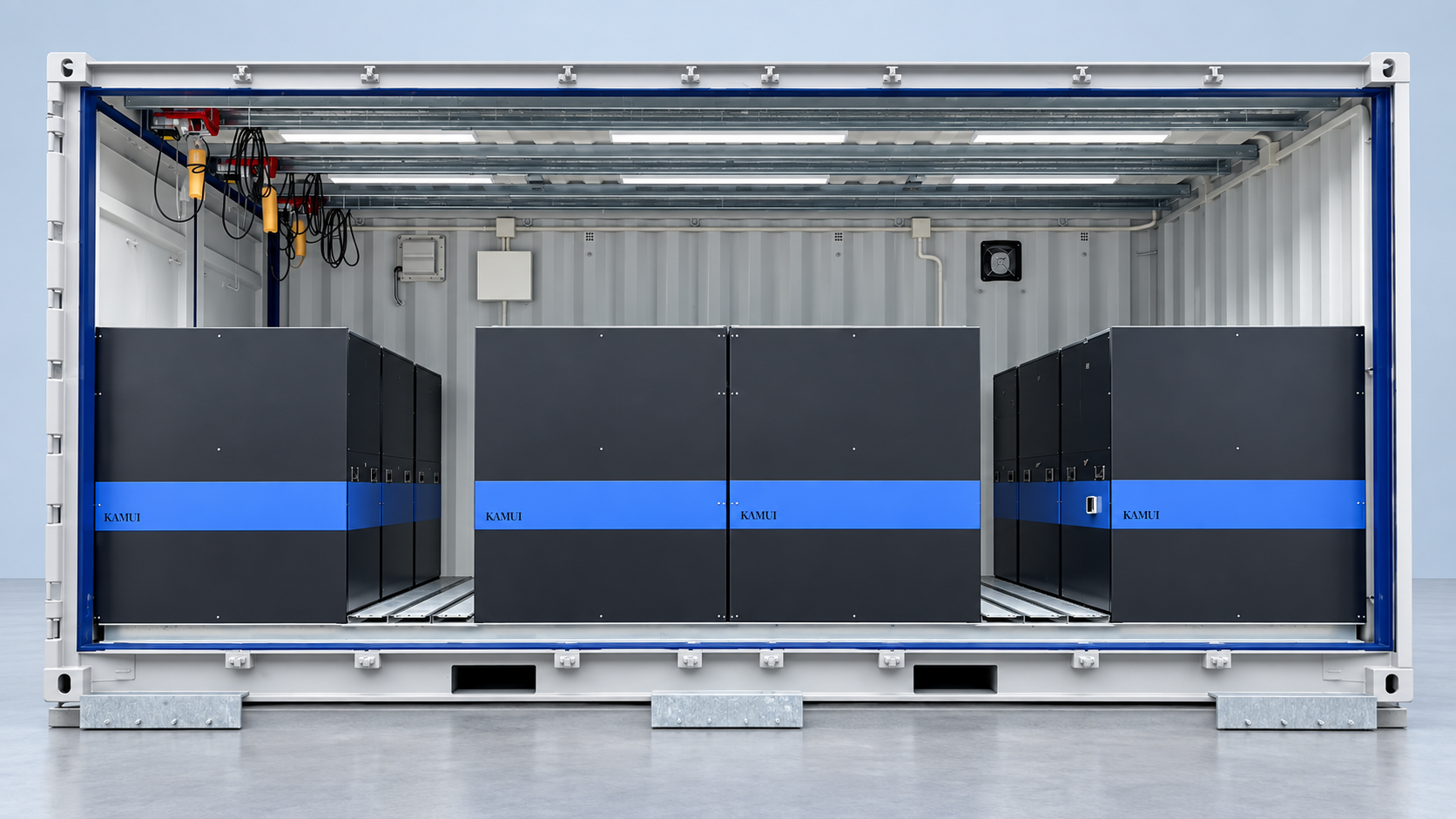
Plan expansion based on the standard 36-rack configuration.Large-scale AI facilities are custom-designed for site conditions.
IMMERSION COOLING
1.3or below
We select configurations after checking the latest GPUs for immersion compatibility, power, heat output, weight, and maintenance requirements.
Immersion cooling design can target PUE of 1.3 or below.
PUE depends on design conditions including load, ambient air, cooling method, and measurement boundary; it is not guaranteed across all configurations or seasons.
OUR EXPERIENCE
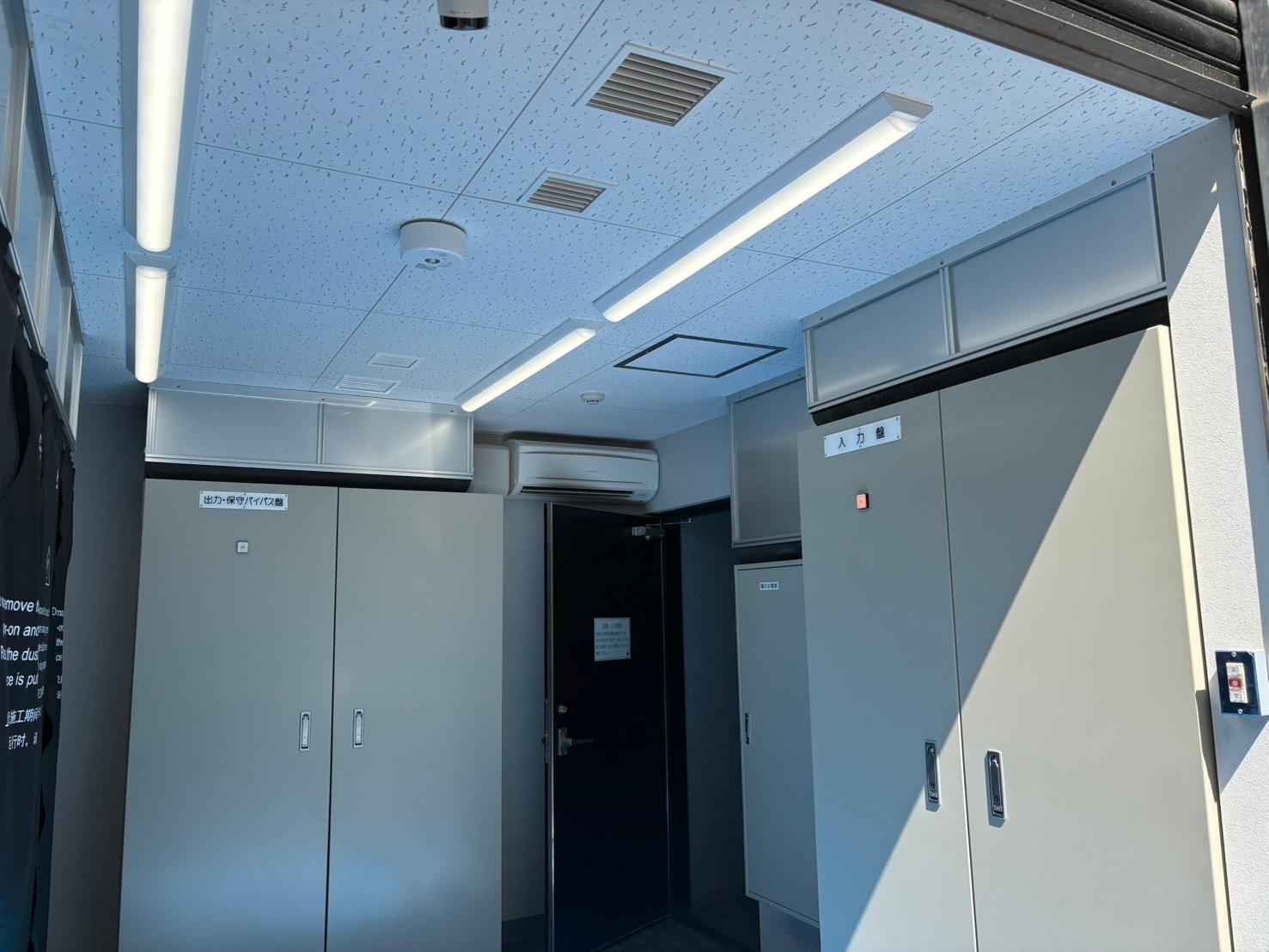
TAKAHAMA, FUKUI
Our data center in Takahama, Fukui, began operating in December 2024.It uses our proprietary immersion cooling technology.
We consider monitoring, maintenance, renewal, and sales conditions from the development stage.We apply our own construction experience to proposals for our customers.
SYSTEM EXAMPLE
An illustrative KAMUI β configuration.
Estimated server load: 1,260 kW (35 kW × 36 racks).
12 racks
12 racks
12 racks
Heat exchange & circulationControl & fire suppression
The diagram summarizes functions; it is not a finalized layout.35 kW per rack is a reference operating load, not a product maximum capacity or a guarantee of equipment support.Each facility system’s capacity is designed individually.
SITE & ENGINEERING
We define the development scope by matching the site, GPU configuration, and required operating conditions.
Access and lifting, ground and foundations, maintenance access, and room for future expansion
IT load, auxiliary loads and losses, incoming power conditions, and UPS and generator coordination
Chillers / groundwater, ambient air, water temperature and quality, and heat rejection and drainage conditions
Connectivity, monitoring, access control, safety equipment, and access for equipment replacement
Area, required power, cooling method, backup capacity, schedule, and costs are finalized based on site conditions and formal design.
PROJECT FLOW
Quantum Mesh coordinates design, KAMUI installation, and work with construction companies and other partners. The schedule varies with incoming power coordination, equipment procurement, permits, and site construction conditions.
Clarify use cases, GPUs, candidate sites, and operating conditions.
Deliverables to review: Requirements document & feasibility
Define layout, power, cooling, and responsibilities.
Deliverables to review: Basic configuration, costs & schedule
Proceed with equipment procurement and foundation, cabling, and piping work.
Deliverables to review: Design drawings & construction records
Verify load testing, outage switchover, and operational readiness.
Deliverables to review: Acceptance, procedures & operational handover
OPERATIONS
From tracking facility conditions and computing resources to maintenance, recovery, and renewal, we also support data center operations after construction.
Back to monitoring
Track temperature, flow, and power. Plan inspections, consumables, replacement parts, and renewal.
Define responsibility for detection, notification, initial response, and recovery, along with shutdown and restart procedures.
Manage GPU usage, available capacity, and contracts, coordinating maintenance and provisioning schedules.
Share facility, operating, and maintenance status to support decisions on improvements and expansion.
Service scope, monitoring hours, on-site response, SLA, equipment warranties, and replacement terms are defined by contract.
COMPUTE BUSINESS
We assess available capacity and contracts, combining direct sales with supply to compatible overseas markets. We clarify responsibilities and compensation from facility operations through sales, billing, and settlement.
DIRECT
Direct provision to customers with long-term requirements.
MARKETPLACE
Sales channels for initial operations and available capacity.
Sales conditions, settlement methods, and Quantum Mesh’s compensation are finalized by contract. Market approval, demand, and other conditions are prerequisites; utilization and revenue are not guaranteed.
PARTNERSHIP
Define business requirements, make investment decisions, and fund data center development. Decide facility ownership and operating policies.
Design the data center, sell and install KAMUI, and coordinate partners. Support data center operations, computing capacity sales, and revenue management.
Carry out specialist foundation, building, electrical, and piping work. Provide construction, inspection, and maintenance within the contracted scope.
We organize the plan to give visibility into capital investment, post-opening costs, and computing capacity sales conditions.
The responsibilities shown are a proposal-stage outline. Facility ownership, revenue sharing, billing and settlement, warranties, and end-of-contract arrangements are agreed individually.
Land, site preparation and foundations, incoming power and connectivity, KAMUI, cooling and power systems, GPUs and IT equipment, design, construction, testing, and handover.
Electricity, connectivity, consumables, maintenance and inspection, outsourced operations, incident response, and equipment renewal and replacement.
Sales conditions, market fees, billing and settlement, and Quantum Mesh’s service scope and compensation.
Prices, returns, and cost-reduction rates are not yet determined. GPU funding and ownership, equipment renewal, taxes, insurance, and other conditions are also considered individually.
LET’S PLAN YOUR DATA CENTER
Even if some details are undecided, we can start with your current conditions. Please share the following four points when you contact us.
Internal use / computing capacity sales, GPU models and quantities, and expansion plans
Candidate sites, building drawings, incoming power, connectivity, and cooling and heat rejection conditions
Tasks you would like to outsource, services to be offered, and required operating conditions
Budget, preferred opening date, and GPU procurement and ownership policies
A formal proposal for PUE, scale, budget, schedule, and operating scope will follow a review of equipment and site conditions.